


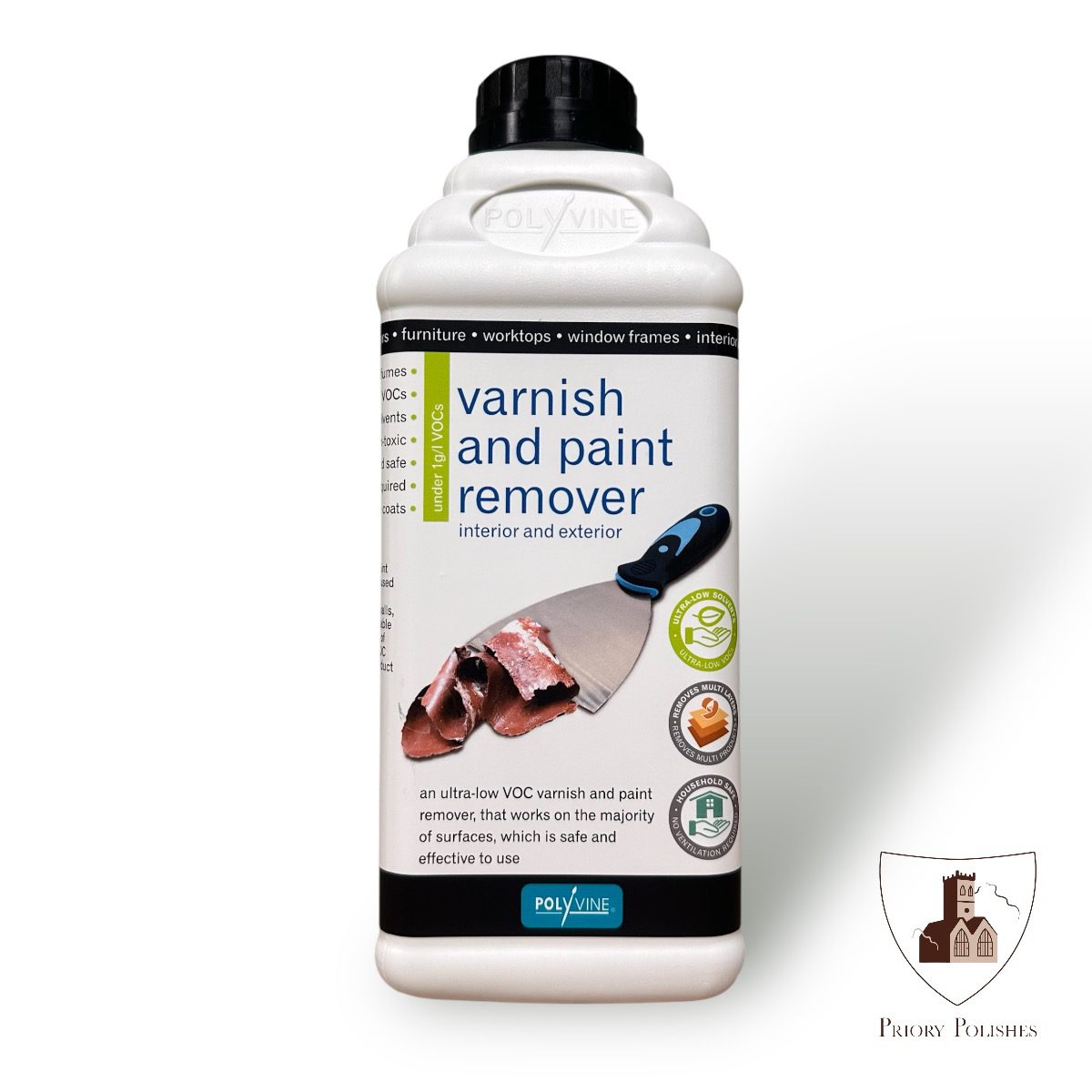
Polyvine Varnish and Paint Remover – 1 Litre
£25.99
Polyvine Varnish and Paint Remover can be used on interior or exterior surfaces. It is the safest varnish and paint remover in the world as the unique emulsion gel is water-based and non-toxic. It removes all oil and water-based paints (including old lead), emulsions, lacquers, varnishes, and polyurethanes. You can use this on all metals including aluminium, wood, brick, slate, plaster, and fibreglass. This varnish and paint remover uses innovative technology that removes all hazardous solvent content and replaces it with water, making this a safe and environmentally responsible product.
- Non-toxic & Household safe
- No ventilation required
- Removes multiple coats
- No fumes
- Ultra-low VOCs & Ultra-low solvents
See Full instructions below
UK FREE delivery on all orders over £24
11 in stock
Description
Polyvine Varnish and Paint Remover is a water-based, non-toxic paint and varnish remover designed to soften and remove multiple layers of paint, varnish, lacquer, polyurethane and other coatings.
Unlike many traditional solvent-based paint strippers, Polyvine Varnish and Paint Remover has ultra-low VOCs and ultra-low solvent content, making it a household-friendly option for removing old finishes.
It can be used on a wide range of interior and exterior surfaces, including wood, furniture, doors, floors, walls, worktops, metal, plaster, brick, stone and ceramic tiles.
- How to Use Polyvine Varnish and Paint Remover
- Why Choose Polyvine Varnish and Paint Remover?
- What Can Polyvine Varnish and Paint Remover Be Used On?
- Polyvine Varnish and Paint Remover for Furniture
- Polyvine Varnish and Paint Remover for Wood
- Polyvine Varnish and Paint Remover for Paint
- Polyvine Varnish and Paint Remover for Varnish
- Frequently Asked Questions
- Please Note
- Health and Safety
- Safety Data Sheets
How to Use Polyvine Varnish and Paint Remover
- Large areas can be coated up without drying out.
- Apply liberally with a brush.
- Remove after the required time with a scraper, or ideally use a stainless-steel scouring ball. (Do not use wire wool as this will create red rust which will stain the surface).
- Apply further coats if required to completely remove the coating.
- Covering with a plastic film will assist in keeping the product adhered to the surface.
- It is the product, not the operative, which does the stripping.
- Cleaning of intricate carvings and/or moulding’s is improved by wrapping in plastic sheeting (cling film or foil) and leaving overnight.
- No special after treatment required. Simply wash down with a wet cloth or, if using on external surfaces, use either a pressure hose or a plastic brush and bucket of water.
Why Choose Polyvine Varnish and Paint Remover?
Polyvine Varnish and Paint Remover has been developed as an alternative to traditional solvent-heavy paint strippers.
Key benefits include:
- Water based
- Ultra-low VOCs
- Ultra-low solvents
- Non-toxic formulation
- Household safe
- No fumes
- No ventilation required
- Removes multiple layers
- Suitable for interior and exterior use
- Suitable for a wide range of surfaces
- No need to neutralise the substrate
- Suitable for removing paint, varnish and lacquer
- Can remove polyurethane coatings
- Suitable for old lead-based paint
- Water clean-up
- This product has VOC content of less than 1g/L and is designed to remove multiple coats without the need for neutralisation.
What Can Polyvine Varnish and Paint Remover Be Used On?
One of the major advantages of Polyvine Varnish and Paint Remover is its versatility.
It can be used on suitable:
- Wood
- Hardwood
- Softwood
- Furniture
- Doors
- Floors
- Walls
- Worktops
- Kitchen cabinets
- Window frames
- Interior woodwork
- Exterior woodwork
- Metal
- Aluminium
- Brass
- Marble
- Stone
- Brick
- Concrete
- Plaster
- Ceramic tiles
- Fibreglass
- GRP
Polyvine Varnish and Paint Remover for Furniture
Polyvine Varnish and Paint Remover is particularly useful for furniture restoration and upcycling.
It can help remove old layers of paint, varnish, lacquer and other finishes from suitable wooden furniture before refinishing.
This makes it useful for:
- Antique furniture
- Painted furniture
- Wooden cabinets
- Sideboards
- Tables
- Chairs
- Chests
- Dressers
- Cupboards
- Upcycling projects
For detailed or ornate furniture, the remover can be left covered with plastic film to help keep the product active for longer. We recommend this technique for intricate carvings and mouldings where appropriate.
Polyvine Varnish and Paint Remover for Wood
Polyvine Varnish and Paint Remover can be used on both hardwood and softwood.
It is suitable for removing many types of old coatings from timber, including paint, varnish, lacquer and polyurethane.
Always carry out a test patch first, particularly when working with veneers, delicate timber or an unknown existing finish. Do not leave the stripper longer than recommended on veneered surfaces.
Polyvine Varnish and Paint Remover for Paint
Polyvine Varnish and Paint Remover can remove both oil-based and water-based paints, including emulsions and old lead-based paint.
It works by softening and plasticising the coating rather than relying on the same chemistry as traditional corrosive or solvent-based strippers. This allows the softened coating to be scraped away from the surface.
Polyvine Varnish and Paint Remover for Varnish
Polyvine Varnish and Paint Remover is designed to remove old varnish and lacquer from suitable surfaces.
It can be particularly useful when preparing wooden furniture, doors, floors and other timber for a new finish.
Polyvine’s older technical guidance gives approximately 15–30 minutes as a guide for wood stains, varnishes, lacquers and shellac, although actual stripping time depends on the coating and substrate.
Frequently Asked Questions
Can Polyvine Varnish and Paint Remover Remove Multiple Coats?
Yes. Polyvine Varnish and Paint Remover is designed to remove multiple layers of coating. For particularly stubborn or heavily built-up finishes, additional applications may be necessary. We recommend applying further coats where required and, for extremely stubborn coatings, covering the remover with plastic film and leaving it overnight before testing a small area for removal.
Can Polyvine Varnish and Paint Remover Remove Polyurethane?
Yes. Polyvine Varnish and Paint Remover is formulated to remove polyurethane coatings, as well as paints, emulsions, lacquers and varnishes. Because polyurethane coatings can vary considerably in formulation and age, always perform a small test area before treating the entire surface.
Can Polyvine Varnish and Paint Remover Remove Lead Paint?
Yes this can be used to remove old lead-based paint. However, lead paint removal requires appropriate precautions because the removed paint and dust can still contain lead. Follow current safety guidance and dispose of removed material responsibly.
Is Polyvine Varnish and Paint Remover Water Based?
Yes. Polyvine Varnish and Paint Remover is water based. The product uses a water-based emulsion gel rather than a conventional solvent-heavy formulation. It is non-toxic with ultra-low VOCs and ultra-low solvent content.
Is Polyvine Varnish and Paint Remover Safe to Use Indoors?
This product is household safe, non-toxic, ultra-low VOC and requires no ventilation and produces no fumes. However, customers should always follow the product label, technical information and appropriate precautions, particularly when removing old or unknown coatings.
Does Polyvine Varnish and Paint Remover Need Neutralising?
No special neutralisation or after-treatment is required. Once the coating has been removed, the surface can be washed down with a damp cloth or water. For exterior surfaces, a pressure hose or plastic brush and bucket of water can be used where appropriate.
How Long Should Polyvine Varnish and Paint Remover Be Left On?
It is recommended to leave the product on the surface for approximately 30–45 minutes before removal. The required time can vary depending on the coating. This can vary depending on the finish but here is an approximate guide –
- Wood stains, varnishes, lacquers and shellac: 15–30 minutes
- Polyurethanes and acrylics: 30–45 minutes
- Multi-layered paint: 1 hour to overnight
How Much Does Polyvine Varnish and Paint Remover Cover?
1 litre of Polyvine Varnish and Paint Remover covers approximately 4–6 square metres, depending on the thickness and type of coating being removed.
What is the difference between Polyvine Varnish and Paint Remover and Traditional Paint Stripper?
Polyvine Varnish and Paint Remover differs from many traditional paint strippers because it is water based and formulated with ultra-low VOCs and ultra-low solvents. It is designed to soften and lift coatings while avoiding many of the hazardous solvents and caustic alkalis traditionally associated with paint removers. This makes it an attractive option for DIY decorators, furniture restorers and professional decorators looking for a lower-VOC alternative.
Can you use Polyvine Varnish and Paint Remover for Antique Restoration?
Polyvine Varnish and Paint Remover can be useful for antique furniture restoration and restoration projects where old paint, varnish or other coatings need to be removed before refinishing. It can be used on suitable wood, including hardwood and softwood, but delicate antiques, veneers and valuable surfaces should always be tested carefully first. For restoration work, avoid aggressive scraping and work gradually to minimise the risk of damaging the underlying substrate.
Please Note
- Always apply to a test area before starting work.
- Do not leave longer than recommended on veneered surfaces
- Recommended stripping times – Multi-Layered paint: 1 hour to overnight. Wood Stains, Varnishes, Lacquers, Shellac: 15- 30 minutes. Polyurethanes & Acrylics: 30-45 minutes. These times are approximations and subject to substrate.
- Varnish & Paint Remover is not a pollutant. Care must be taken to ensure that any paint solids do not enter surface water drains.
- Do not mix with other products.
- Lead paint is one of the major sources of lead in older houses. It is recorded that about two-thirds of the homes built before 1940, and one-half of the homes built from 1940 to 1960 have been decorated with lead-based paint. Some homes built in the 60’s and early 70’s may contain some lead too. Polyvine Varnish and Paint Remover is a “working wet system” that keeps the paint wet at all times, significantly reducing any risk of dust and therefore exposure to harmful particles.
- Storage Conditions – Do not allow it to freeze.
- Coverage: approximately 4-6 sq. metres per litre
Health and Safety
This white emulsion gives a slight almond odour but without any fumes. Melting point less than –10 degrees C with a boiling point of 101 degrees C. PH neutral. This product can be used in confined spaces without any respiratory protection; however, some softened paints may give off toxic fumes. Does not burn the skin, but protective gloves are recommended for long exposure. Non-hazardous. Ensure good ventilation. Keep out of reach of children. Contact with eyes: wash immediately with warm water. Remove excess from tools and mixing vessels before washing in warm soapy water. Do not empty containers into drains or watercourses.
Safety Data Sheets
1 review for Polyvine Varnish and Paint Remover – 1 Litre
You may also like…
-

Polyvine Metal Leaf Size
Price range: £4.72 through £21.12 Select options This product has multiple variants. The options may be chosen on the product page -
Polyvine Varnish Brush – 2″
£11.67 Add to basket -
Polyvine Metallic Paint – 500 ml
£22.16 Select options This product has multiple variants. The options may be chosen on the product page -
Polyvine Crackle Glaze
Price range: £6.34 through £32.26 Select options This product has multiple variants. The options may be chosen on the product page


Related products
-
Repair King furniture Care Pack – Wax Filler Sticks
£10.00 Select options This product has multiple variants. The options may be chosen on the product page -
Rustins Scratch Cover – Covers Scratches on Wood
£6.29 Select options This product has multiple variants. The options may be chosen on the product page -
Liberon Shellac Filler Sticks
£10.99 Select options This product has multiple variants. The options may be chosen on the product page


Richard Taylor (verified owner) –
Vital as the nontoxic aqueous alkaline gel paint stripper for a multi coat alkyd system over a stoved black linseed oil/copal enamel , 100 years old,on zamac diecasting. This century old enamel had overpolymerised and microcrystalline glass formed ,totally unsuitable as a base coat. Removal of the total system was easily achieved by thick application and working in, application of a second complete layer, covering in polythene to prevent loss of water and leaving in a warm airing cupboard for 48 hours. Then the depolymerised , hydrolysed, loosened film was scraped off, back to the bare metal . All this was due to the power of Polyvine, without the hazard of the solvent containing types. The lifted paint went into the waste bin, suitably wrapped,the detergent washed zamac was dried, washed in citric acid to deal with zinc salts ,using the solution on hot metal to give an etch as well. Then, for the fine detail that the Polyvine removal revealed, these parts were etched primed , then acrylic primer filler sprayed and spray finished in colour coat. The plain bodywork was 2k epoxy brush primed, flatted and spray colour finished without the primer filler. Polyvine allowed this attention to detail on this classic O scale locomotive without it becoming a chore; by comparison , the cleaning of two similar loco models using gel solvent based material took 10 days for each one. I am a degree and MSc qualified paint chemist and ex-MoD Chief Camouflage Scientist- we use polymeric bead blasting for paint removal, not possible in the garage. But Polyvine is equivalently quick and simpler for DIY work; I have a Parker Knoll clear varnished table as the next item for Polyvine magic, to befollowed by a stain and tough clear coat. Again, speedy with Polyvine and a more usual application for the DIY public to read. The loco one is for the enthusiasts dealing with the problems encountered with 1920 1930 zamac diecast classic steam locomotives , in the twilight of the stoved oleoresinous/fossil resin coatings