
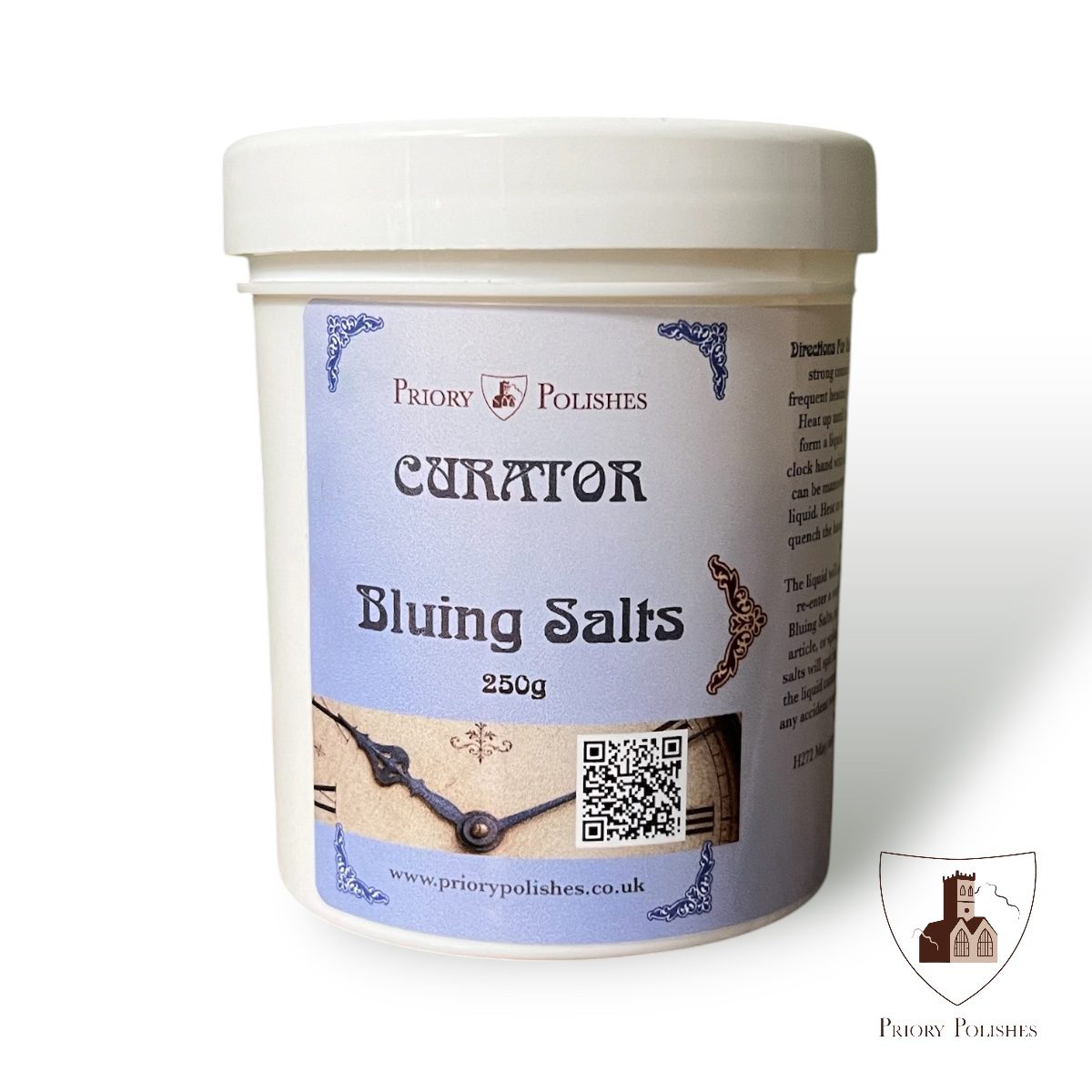
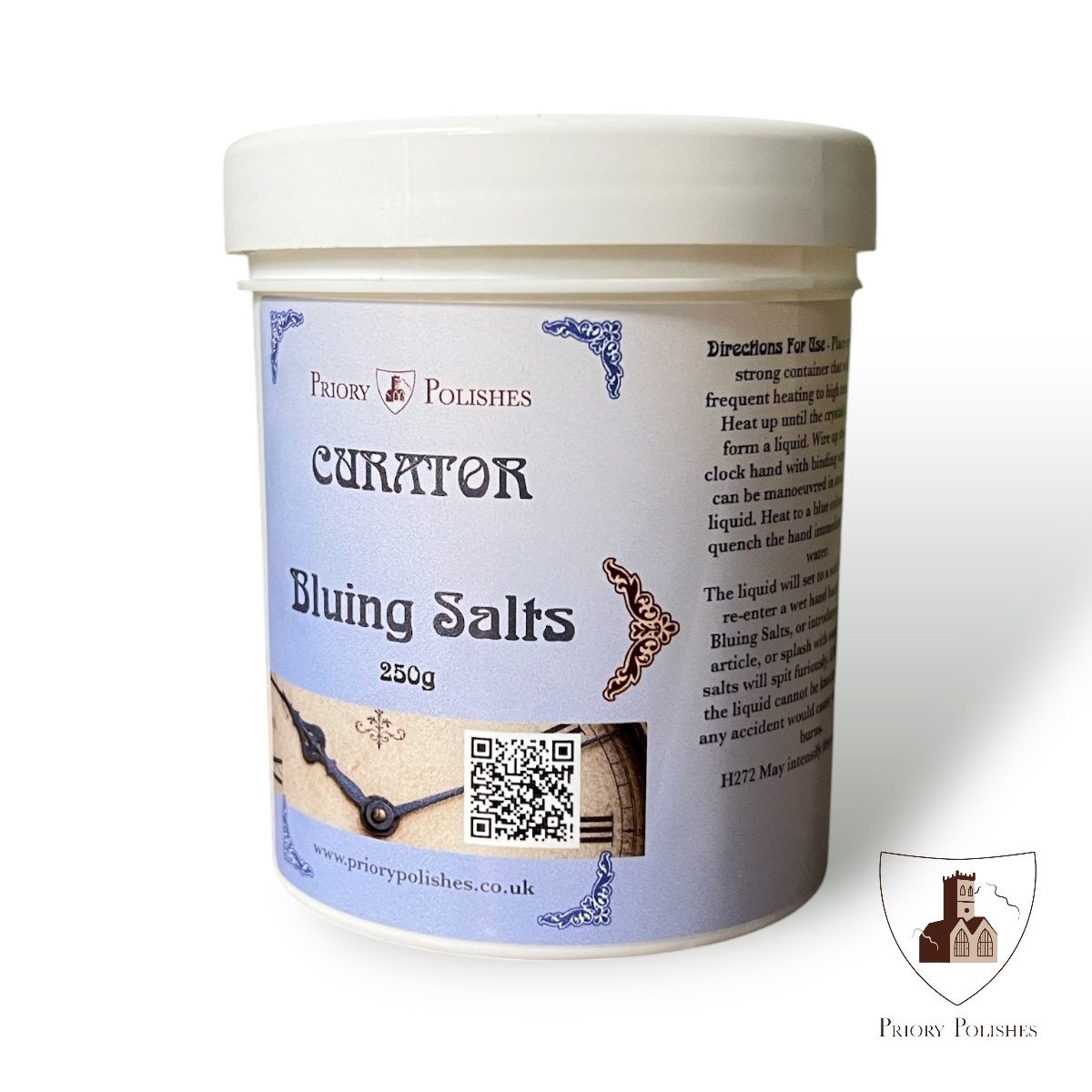


Curator Bluing Salts
£15.95
Curator Bluing Salts for creating deep blue-black oxide finishes on steel. Ideal for metal restoration, steel clock hands, gun bluing and traditional metal finishing.
- Professional bluing salts for steel metal finishing
- Creates deep blue-black oxide finishes on steel surfaces
- Ideal for bluing steel clock hands, gun bluing, metal restoration and traditional finishing
- Suitable for tools, firearms components, fittings and steel hardware
- Trusted by professional restorers, metalworkers and craftsmen
See full instructions below
UK FREE delivery on all orders over £24
987 in stock
Description
Curator Bluing Salts are a professional metal finishing compound used to create a traditional deep blue-black oxide finish on steel.
They are particularly useful for clock restoration, metal restoration and traditional steel finishing, including bluing steel clock hands and other small steel components.
The salts are heated until they melt into a liquid bath. The prepared steel component is then immersed in the hot bluing salts to produce the characteristic blue-black appearance associated with traditionally blued steel.
Uses for Bluing Salts
Curator Bluing Salts are suitable for a range of steel finishing and restoration applications, including:
- Steel clock hands
- Clock restoration
- Small steel components
- Steel tools
- Gun Bluing
- Steel fittings and hardware
- Traditional metal finishing
- Metal restoration projects
- Suitable firearms components
They are particularly useful where an authentic blue-black blued steel appearance is required rather than a painted or plated finish.
Bluing Steel Clock Hands
Curator Bluing Salts are especially useful for restoring the traditional blue finish found on clock hands. The process allows a cleaned steel hand to be treated to produce a deep blue colour appropriate for traditional horological restoration.
The temperature of the molten salts helps ensure that different thicknesses of steel can be heated consistently during the process, allowing the blueing colour to develop evenly.
How to Use Curator Bluing Salts
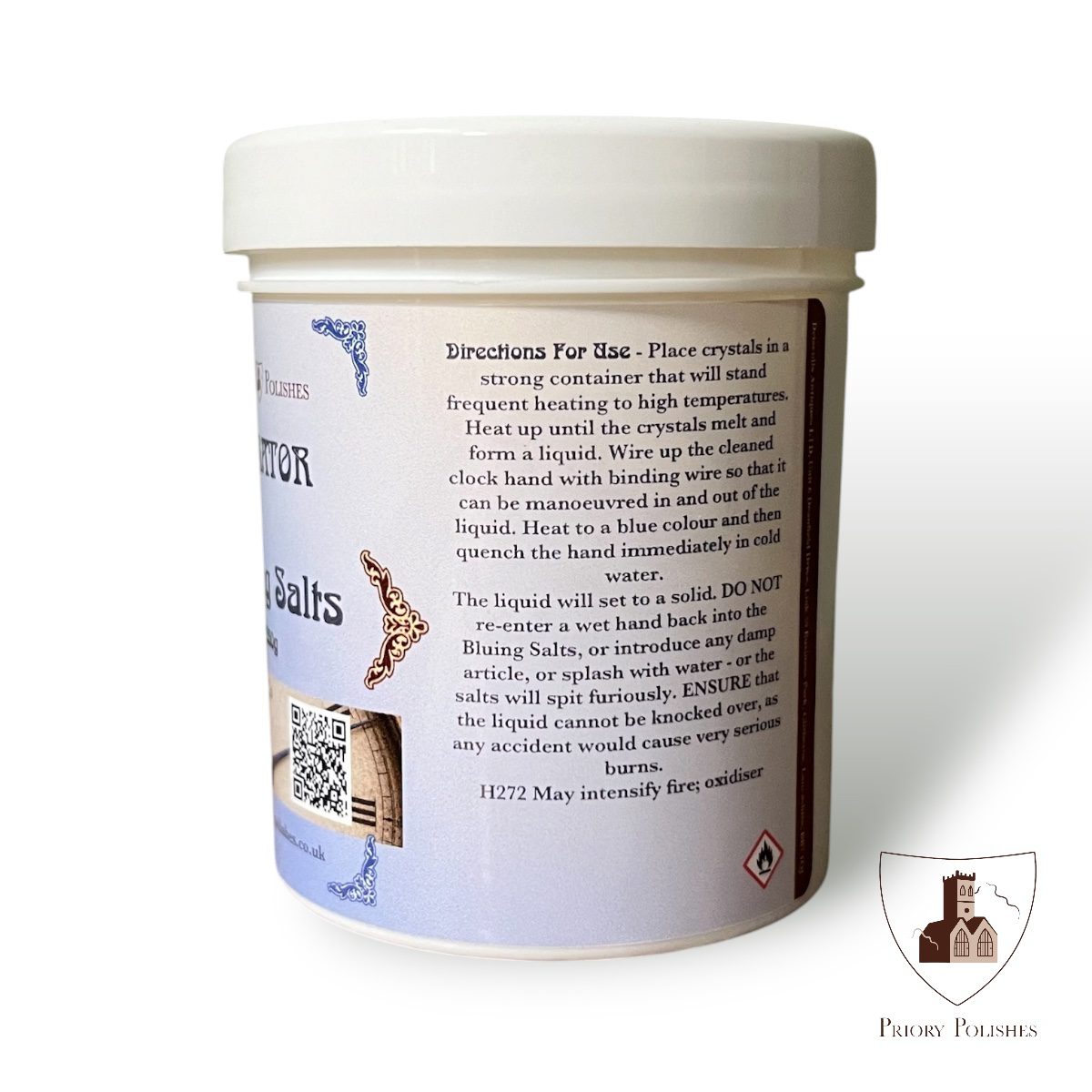
- Place the bluing salt crystals into a strong heat-resistant container suitable for repeated heating to high temperatures.
- Heat the crystals until they melt and form a liquid.
- Clean the steel component thoroughly before treatment.
- Attach suitable binding wire to the steel component so it can be safely manoeuvred in and out of the molten salts.
- Immerse the steel component into the molten bluing salts.
- Lift it out periodically to allow the oxidation and blue colour to develop.
- Continue until the desired shade of blue has been reached.
- Quench the component immediately in cold water.
- Allow the component to cool and dry thoroughly.
The bluing salts themselves do not directly create the blue colour. Their purpose is to maintain an even temperature so that the steel can blue consistently during the process.
Achieving the Blue-Black Finish
The finished colour develops as the steel is heated in the molten salts. The exact shade can vary according to the steel, preparation, temperature and treatment time.
Monitor the component during treatment and remove it once the desired shade has been achieved.
Important: once the steel has been quenched in cold water, do not put it back into the hot bluing salts. The sudden introduction of a cooled component can cause the molten salts to spit violently.
When cold, the bluing salts will set solid. The solidified salts can be reheated and reused for subsequent bluing work.
Frequently Asked Questions
What are Curator Bluing Salts used for?
They are used to create a traditional deep blue-black oxide finish on steel, particularly for clock hands, metal restoration and traditional steel finishing.
Can I use them for clock hands?
Yes. Curator Bluing Salts are particularly suitable for bluing steel clock hands during clock restoration.
What colour do bluing salts produce?
They produce a traditional blue to blue-black finish on suitable steel components.
Do the salts need to be heated?
Yes. The crystals need to be heated until they melt and form a liquid bath before the steel component is immersed.
Are the bluing salts reusable?
Yes. Once cooled, the molten salts solidify. They can be reheated and reused for further bluing work.
Can the salts be used on steel tools and fittings?
Yes. They can be used for suitable steel tools, fittings, hardware and other steel components where a traditional blued finish is required.
Why is the steel quenched in cold water?
Quenching in cold water is part of the finishing process and stops the treatment once the desired blue colour has been achieved.
Can cooled steel be put back into the molten salts?
No. Do not put the component back into the bluing liquid after it has been cooled in water, as this can cause the molten salts to spit violently.
Important Safety Information
Curator Bluing Salts require heating to high temperatures and produce a molten liquid. This process presents a serious burn and heat hazard and should only be carried out by someone familiar with hot metal-finishing processes.
- Use a strong, suitable heat-resistant container.
- Wear appropriate protective clothing, gloves and eye/face protection.
- Take extreme care when handling the molten salts.
- Ensure the container is stable and cannot easily be knocked over.
- Keep water and moisture away from the molten salts.
- Never introduce a cooled component back into the molten bluing liquid.
- Work in a suitable, controlled and well-ventilated area.
- Keep away from children and anyone not involved in the process.
Take particular care to prevent the molten salts from being knocked over. An accident involving the hot liquid could cause serious burns.
You may also like…
-

Curator Protective Oil
Price range: £12.95 through £106.95 Select options This product has multiple variants. The options may be chosen on the product page -
Curator Antiquing Gel Black
£15.95 Add to basket -
Curator Antiquing Fluid Trial Pack
£23.95 Add to basket -
Curator Antiquing Fluid
Price range: £11.95 through £145.00 Select options This product has multiple variants. The options may be chosen on the product page


Related products
-
Liberon Wood Bleacher – 500ml
£14.95 Add to basket -
Priory Polishes Polish Reviver
Price range: £12.95 through £149.00 Select options This product has multiple variants. The options may be chosen on the product page -
Liberon Liming Wax – For a Whitewash Effect
Price range: £13.95 through £19.99 Select options This product has multiple variants. The options may be chosen on the product page


Reviews
There are no reviews yet